Leadership logic. Role fit. Impact.
The Schwall Leadership Navigator is a theory-based profile and a structured reflection on leadership logic (how someone prefers to lead), motivation, role fit and retention factors. It adds a further basis for decisions to the CV, interviews and references; it does not replace them.
Not every strong leader is effective in every context
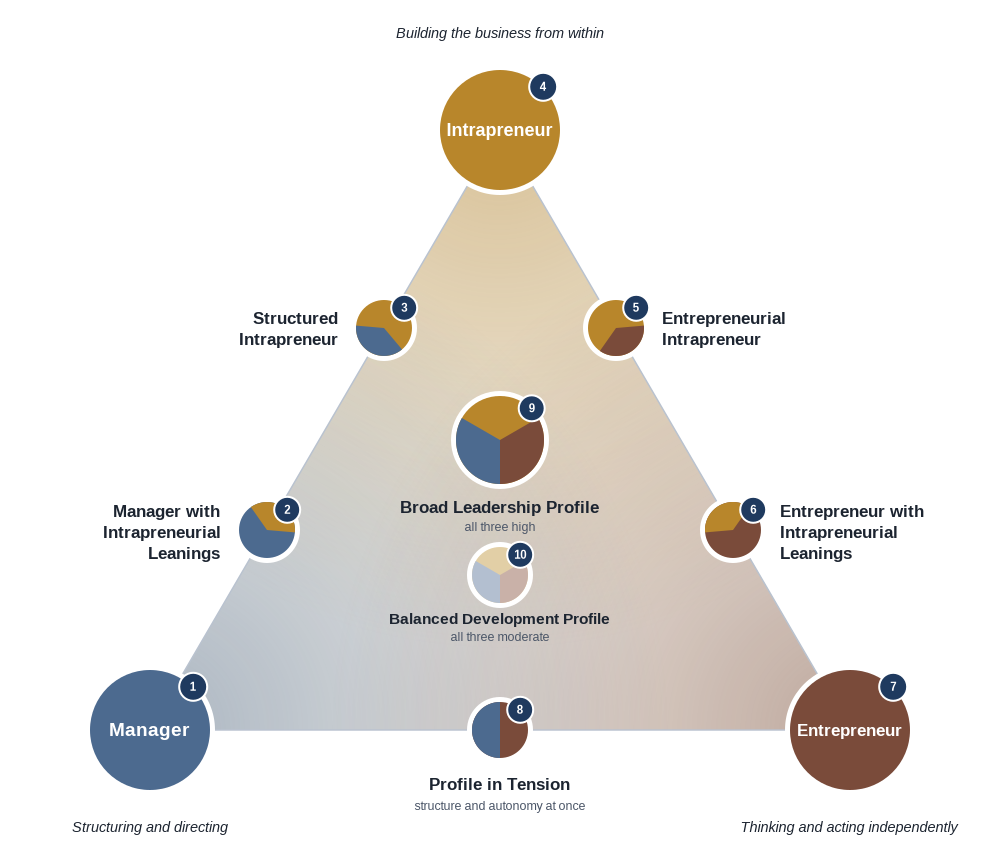
Professional experience and a track record matter. What is decisive, though, is how a leader handles responsibility, structure, autonomy, risk and entrepreneurial impact. The Navigator therefore distinguishes three leadership logics.
Structure and direction
Stands for stabilisation, order, reliable processes and dependable execution. Managers create clarity, keep processes secure and contain risk.
Typical settings: mature organisations, operations and quality, efficiency programmes.
Entrepreneurial action within an organisation
Combines entrepreneurial thinking with being embedded in the organisation and the ability to deliver. Seeks autonomy, takes responsibility and turns ideas into results.
Typical settings: transformation, growth and succession, new business areas, mid-sized, often owner-managed companies (the German Mittelstand).
Marked independence
Stands for independence, a vision of their own, a willingness to take risks and a strong drive to build. Thinks in terms of business models, market opportunities and personal responsibility.
Typical settings: building and founding businesses, turnarounds with full authority, autonomous units.
Context is part of the interpretation
A profile is never read in isolation. Interpretation always takes account of:
Company stage
Start-up, growth, maturity, professionalisation, restructuring and succession each call for a different leadership logic.
Role brief
The outcomes the role must deliver, the time horizon and the depth of change involved.
Decision rights
Which decisions the person can actually take, and which sit with committees or further up the reporting line.
Governance
Shareholders, advisory board, executive management, matrix: how closely decisions really have to be agreed with others.
Autonomy in practice
It is the freedom experienced in practice, not the freedom promised, that determines effectiveness and retention.
Career examples
Specific leadership experiences, successes and failures give the tendencies substance in conversation.
36 statements, three scores, one conversation
The participant rates 36 statements drawn from practice on a five-point scale. For each leadership logic, twelve answers produce a score of between 20 and 100 per cent.
The three scores are shown as separate bars. They do not add up to 100 per cent and are neither percentiles nor probabilities of success. The relationship between the scores determines a profile type, and each type has its own curated, version-controlled report texts. These cover the basic profile, leadership logic, motivational structure, strengths, risks in the wrong context, retention factors and leadership conditions, and specific questions to explore.
All interpretations are framed as working hypotheses. The assessment becomes robust only in the feedback session, when it is set against the role, the organisation and examples from the participant’s career.
What the Navigator is not
- Not a clinical personality test
- Not a psychometrically normed or scientifically validated selection test
- Not a full assessment of competencies
- Not a rigid typology and not an automatic verdict on suitability
- Not a ranking and not a percentage match to occupations
- Not a substitute for interviews, references and clarifying the role
The context questionnaire (current role, occasion, role under consideration, desired degree of autonomy) supplements the report but does not affect the scores.
Person, role and environment in context
The individual leadership profile shows how a person prefers to lead and shape things. In professional use, the Role and Environment Check adds the demands of the specific role and the conditions in the organisation to this perspective.
The individual leadership profile
- 36 statements on a five-point scale
- Three leadership logics: Manager, Intrapreneur and Entrepreneur
- Three separate orientation scores and a profile type
- Core profile, leadership logic and motivational structure
- Strengths, risks in an unsuitable environment, retention and leadership conditions
- Personal feedback session
Completed by the leader themselves.
The Role and Environment Check
The check adds a structured look at the specific leadership role and the organisational environment to the leadership profile.
- 18 role statements in six areas: which leadership logic does the role require?
- 24 environment characteristics in six dimensions: what does the organisation actually allow?
- Comparison of role, person and environment with notes for discussion and guiding questions
- In professional use supported by Dr. Jörg Schwall or a certified practitioner; optional and included in the price with a self-booked profile
The company describes the role and the environment – with a self-booked profile, the leader can do so themselves if they wish. It is the role that is assessed, not the person. It takes about 15 minutes.
Six areas of the role
Three statements per area – one for each leadership logic.
- Mandate
- Stage of the business
- Nature of the task
- Risk and uncertainty
- Integration into the organisation
- Measure of success
Six dimensions of the environment
Four characteristics per dimension on a scale from 1 (closely managed) to 5 (largely autonomous).
- Decision rights
- Governance and reporting lines
- Leadership culture
- Incentive system
- Resources and room to shape
- The organisation’s readiness for change
How the three perspectives are compared
Role and person
For each leadership logic, the demand of the role and the person’s score are placed side by side. A gap of less than 10 points counts as a fit, 10 points or more as something to clarify, and 20 points or more as a clear gap or a clear surplus.
Role and environment
For each dimension it becomes visible whether the environment supports the mandate or is narrower than the mandate. A narrow environment combined with a far-reaching mandate can point to the risk of a “mandate without authority”.
Person and environment
For each dimension it becomes visible whether the environment fits the person’s leadership logic, is narrower (risk of feeling constrained) or wider (risk of lacking orientation).
For day-to-day leadership work, this produces a shared picture: where person, role and environment fit, where a demand should be clarified in conversation, and where the environment may limit the leadership that is required. Interview questions, decision rights, onboarding expectations and development steps can be derived from it.
From research to a tool for conversation
The conceptual foundation of the Navigator is Dr. Jörg Schwall’s doctoral thesis at the German Sport University Cologne: “Zur Beschaffung und Motivation von Führungskräften…auf der Basis des Führungskräftemodells des Intrapreneurs und der Anreiz-Beitrags-Theorie” (“On the recruitment and motivation of executives … based on the intrapreneur model of leadership and inducement–contribution theory”).
The thesis examined executive profiles, motivational structures and the incentives under which entrepreneurially minded leaders become effective within an organisation and stay with it for the long term. Its theoretical starting point was the distinction between Manager, Intrapreneur and Entrepreneur, with the Intrapreneur profile at its centre.
Questions from that academic work on leadership and motivation have since been developed into a contemporary, practical instrument for reflecting on leadership logic, role fit and organisational context.
See what a report looks like
The sample report shows an entirely fictitious profile, with every chapter and an explanation of the scores. No registration required.